
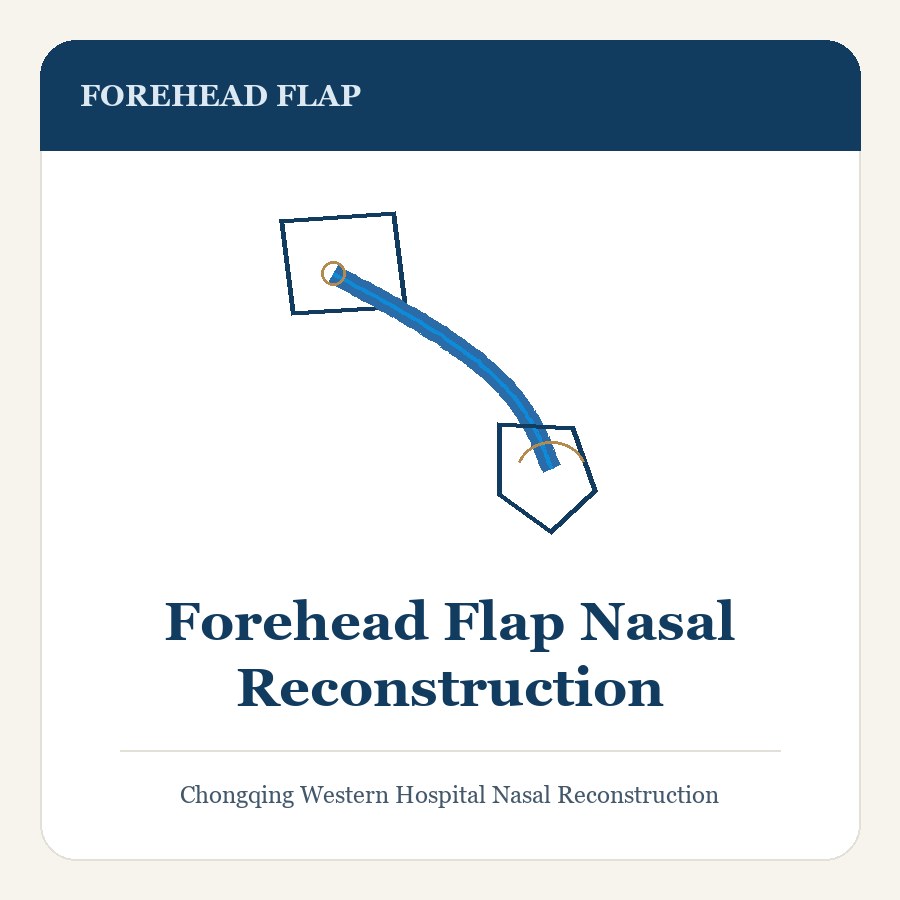
In short. The workhorse of nasal reconstruction: how a forehead flap works, its stages, the temporary pedicle, and the honest cost of a donor-site scar.
Key points
- The forehead is the closest available match for nasal skin in colour, thickness and sebaceous quality, and it keeps its own blood supply while it heals into place.
- That combination makes it the most dependable option for defects involving the alar rim, the tip, or more than one subunit.
- A graft or small local flap cannot reproduce those qualities, and on a defect this size a failed graft means starting again.
For large or full-thickness nasal defects, the forehead flap is the standard answer. It brings a block of skin and soft tissue from the forehead to the nose while keeping its own blood supply attached, which lets it survive on a wound that a graft could never cover. It matches facial skin better than tissue taken from anywhere else, and it costs the patient a scalp scar and weeks of a temporary attachment.
How it works
A flap is a piece of tissue moved with its blood vessels still connected. The forehead flap is based on vessels that run up the side of the forehead near the temple, so a paddle of skin can be lifted from the middle of the forehead and rotated down to the nose while a narrow bridge of tissue — the pedicle — keeps it alive. That bridge stays attached through the first stage, which is why a patient leaves the operating theatre with a tube of skin from the forehead to the nose.
The stages
Stage one raises the flap and attaches it to the nose, and if lining or support is needed, those are rebuilt in the same operation. Stage two, usually three to four weeks later, divides the pedicle and returns the unused bridge to the forehead. Stage three, often months later, is a refinement: thinning the flap, adjusting the contour, and sometimes revising the donor site. Two stages is common; three is not unusual.
Why surgeons still choose it
The forehead is the closest available match for nasal skin in colour, thickness and sebaceous quality, and it keeps its own blood supply while it heals into place. That combination makes it the most dependable option for defects involving the alar rim, the tip, or more than one subunit. A graft or small local flap cannot reproduce those qualities, and on a defect this size a failed graft means starting again.
What the donor site costs
The forehead scar is permanent. It is sometimes a fine line that hair styling conceals, and sometimes wider and more visible, particularly if the forehead was tight or the flap large. Patients should accept this trade before stage one, not after, because the scar is the price of the flap rather than a complication of it.
Recovery
The first weeks involve a dressing and a flap that looks unusual and feels strange. The pedicle limits washing, hairstyling and sleeping position. Once it is divided, life becomes considerably more normal. Swelling settles over weeks, the flap softens over months, and the final result is assessed at six to twelve months.
It is a demanding process, measured in months. It is also, for the right defect, the most reliable way to rebuild a nose.
Contact the team promptly if
- The flap becomes dusky, cool or dark at the edges, or its colour changes suddenly rather than gradually.
- There is bleeding under the flap, a rapid increase in swelling, or a dressing soaked through.
- Fever, spreading redness or discharge develops at either the nasal or the forehead site.
Frequently asked questions
What is a forehead flap?
A block of skin and soft tissue lifted from the forehead and rotated down to the nose while a narrow bridge of tissue, the pedicle, keeps its blood supply attached. That bridge stays connected through the first stage, which is why a patient leaves theatre with a tube of skin from forehead to nose.
How many stages does a forehead flap take?
Stage one raises the flap and attaches it to the nose, rebuilding lining or support in the same operation if needed. Stage two, usually three to four weeks later, divides the pedicle. Stage three, often months later, refines the contour and sometimes the donor site. Two stages is common; three is not unusual.
What does the forehead donor site cost?
A permanent scar. It is sometimes a fine line that hair styling conceals, and sometimes wider and more visible, particularly if the forehead was tight or the flap large. Patients should accept this trade before stage one, because the scar is the price of the flap rather than a complication of it.
Risks & Limitations
- Nasal reconstruction is usually staged — two to four operations over months is normal, and the plan may change as healing progresses.
- A forehead flap leaves a permanent donor-site scar on the forehead and a temporary pedicle that looks unusual while it heals.
- Matching the colour and texture of facial skin is imperfect; a graft or flap usually stays slightly paler or thicker than the nose around it.
- Partial or complete failure of a graft or flap, which may require further surgery and a new plan.
- Narrowing of the airway, which can develop months or years later as scar contracts.
- Further revision is often needed to refine contour, thin a flap or release a narrowed airway.
- Altered or reduced sensation in the nose and, after a forehead flap, in the forehead.
- Final assessment is made at 6–12 months, never at the first dressing change.
When to Seek Care
- A flap or graft that turns dark, cold or black, or a wound that opens and does not close.
- Fever above 38 °C, or spreading redness, warmth or discharge around a wound.
- Difficulty breathing through the nose that worsens rather than settles.
- Bleeding that does not stop with gentle pressure.
- Severe pain, or a tense swelling under a flap or around the reconstruction.
References & Further Reading
- American Society of Plastic Surgeons (ASPS) — reconstructive surgery guidance
- Cochrane Library — systematic reviews in wound and reconstructive care
- Chinese Medical Association, Plastic Surgery Branch — clinical guidance
- World Health Organization (WHO) — surgical safety and emergency care resources
This page is patient education, not medical advice, and it does not cite individual studies. Discuss your own case with a qualified clinician. To arrange an assessment at Chongqing West District Hospital, see Contact & Consultation.