
In short. From skin graft to composite free flap: how surgeons choose the simplest repair that will work, and why the simplest option is not always the right one.
Key points
- Three questions decide the rung.
- Does the defect need new lining, or is the mucosa intact?
- Does it need structural support, or is the framework preserved?
When nasal tissue is lost, the question is never simply how to close the hole. It is which of several very different techniques will restore cover, contour and function with the fewest operations and the least risk. Surgeons think about that choice using a framework called the reconstructive ladder, and understanding it helps patients make sense of the plan they are offered.
The rungs
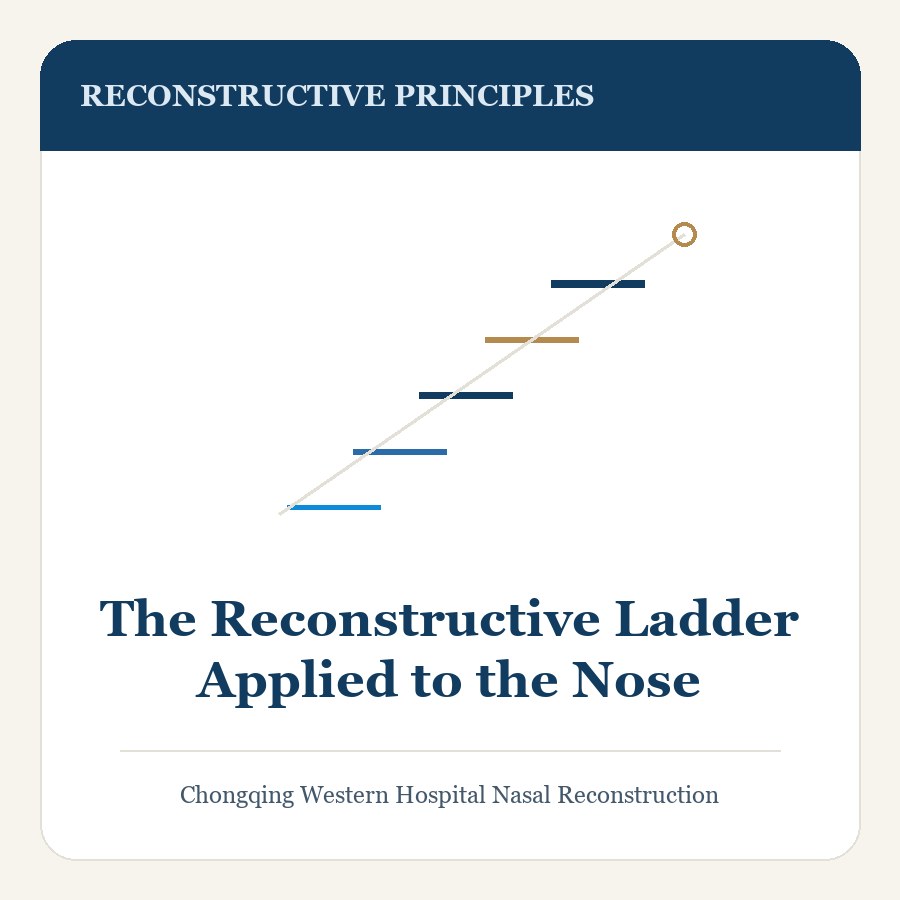
The ladder climbs from simple to complex: healing by itself, direct closure, skin grafting, local flaps taken from the nose, regional flaps borrowed from the forehead or cheek, and finally free tissue transfer, where a block of tissue is moved with its blood vessels and reconnected under the microscope. Good judgement means climbing only as high as the defect demands, never as high as the surgeon is technically able to go.
Why the lowest rung is not always right
A skin graft is quick and reliable, but it needs a healthy bleeding bed to survive and it cannot replace lost cartilage. On the nose it often heals as a shiny, pale patch that sits on the surface like a stamp and contracts as it matures. On a shallow defect over the dorsum that may be an excellent result. Over the alar rim, where the graft has to fold around a curved edge and hold the airway open, it very often is not.
Choosing by requirement, not by habit
Three questions decide the rung. Does the defect need new lining, or is the mucosa intact? Does it need structural support, or is the framework preserved? Does the repair have to match thick, sebaceous, sun-exposed facial skin, or is a colour difference acceptable there? A defect that needs lining and support cannot be solved with a graft however small it is, and a defect confined to cover rarely justifies a forehead flap.
Staging is part of the choice
Some rungs require more than one operation. A forehead flap is almost always two stages and sometimes three. A composite free flap is one long operation with a hospital stay and close monitoring afterwards. The ladder is therefore not only about complexity but about how many times a patient is willing and able to be operated on.
What the ladder cannot decide
The ladder is a framework, not an answer. It does not weigh general health, the state of the surrounding skin, smoking, previous surgery or previous radiotherapy, all of which push the plan higher or rule a rung out entirely. It also says nothing about what matters most to the person being operated on, which is why the choice is made with the patient rather than for them.
Assessed honestly, the rung chosen is the lowest one that will still work in that specific nose, in that specific person, at that specific time.
Ask before you agree
- Which layers of my nose are actually missing, and which of them will this plan rebuild?
- How many operations does this plan involve, and over what period of time?
- What happens if this plan fails — what is the next option, and is it still available to me?
Frequently asked questions
What are the rungs of the reconstructive ladder for the nose?
Healing by itself, direct closure, skin grafting, local flaps taken from the nose, regional flaps borrowed from the forehead or cheek, and free tissue transfer, where tissue is moved with its blood vessels and reconnected under the microscope. Good judgement means climbing only as high as the defect demands.
Why is a skin graft sometimes the wrong choice on the nose?
Because it needs a healthy bleeding bed and cannot replace lost cartilage. On the nose it often heals as a shiny pale patch that sits on the surface like a stamp and contracts as it matures. On a shallow defect over the dorsum that may be excellent; over the alar rim it very often is not.
What three questions decide which technique is used?
Does the defect need new lining, or is the mucosa intact? Does it need structural support, or is the framework preserved? And does the repair have to match thick, sun-exposed facial skin? A defect needing lining and support cannot be solved with a graft however small it is.
Risks & Limitations
- Nasal reconstruction is usually staged — two to four operations over months is normal, and the plan may change as healing progresses.
- A forehead flap leaves a permanent donor-site scar on the forehead and a temporary pedicle that looks unusual while it heals.
- Matching the colour and texture of facial skin is imperfect; a graft or flap usually stays slightly paler or thicker than the nose around it.
- Partial or complete failure of a graft or flap, which may require further surgery and a new plan.
- Narrowing of the airway, which can develop months or years later as scar contracts.
- Further revision is often needed to refine contour, thin a flap or release a narrowed airway.
- Altered or reduced sensation in the nose and, after a forehead flap, in the forehead.
- Final assessment is made at 6–12 months, never at the first dressing change.
When to Seek Care
- A flap or graft that turns dark, cold or black, or a wound that opens and does not close.
- Fever above 38 °C, or spreading redness, warmth or discharge around a wound.
- Difficulty breathing through the nose that worsens rather than settles.
- Bleeding that does not stop with gentle pressure.
- Severe pain, or a tense swelling under a flap or around the reconstruction.
References & Further Reading
- American Society of Plastic Surgeons (ASPS) — reconstructive surgery guidance
- Cochrane Library — systematic reviews in wound and reconstructive care
- Chinese Medical Association, Plastic Surgery Branch — clinical guidance
- World Health Organization (WHO) — surgical safety and emergency care resources
This page is patient education, not medical advice, and it does not cite individual studies. Discuss your own case with a qualified clinician. To arrange an assessment at Chongqing West District Hospital, see Contact & Consultation.